The $27 Billion Swag Budget Deserves Better Than Just the Designation of a Giveaway
You're activating at a festival. Or trade show. Or a product sampling tour. Or a stadium sponsorship. Doesn't matter if it's B2B or B2C because the dynamic is the same. You've invested in branded promotional products: water bottles, t-shirts, tote bags, tech accessories. You've designed them carefully. You've negotiated the unit costs. You've shipped them to each venue.
And then, in every planning document, every recap deck, every budget line item, they get labeled the same way: giveaways.
Our industry has devalued a powerful tool to entice or meet the event objective.
A giveaway is something you get rid of. Something with no expectation of return. Something you hand to whoever happens to walk by, because the goal is simply to empty the boxes before you have to load them back into the truck.
That is not what these items are. That's not what they do. And a $27 billion industry deserves better than a term that treats its products like an afterthought.
The U.S. promotional products industry reached $26.78 billion in 2024, according to PPAI's Distributor Sales Volume Estimate, with growth continuing despite economic headwinds. A massive portion of that spend flows directly into event marketing: trade shows, experiential activations, sampling programs, sponsorship fulfillment, conferences, festivals, community events. Every vertical. Every audience type. Every objective from awareness to conversion.
And yet, when it comes to measurement, we treat these items like they're invisible the moment they leave our hands.
When someone on your team, maybe Amanda, maybe a brand ambassador, or a volunteer, standing at the booth or the sampling station with a clicker. Click. Click. Click. 30 minutes into the activation, the clicking becomes inconsistent because humans get tired. At teardown, someone eyeballs the leftover inventory. "Looks like we distributed about 3,200." That number goes into the recap alongside twelve photos of smiling attendees holding the product from various angles, and yes, “smiles and thank yous” are important, but not enough.
That’s measurement. That's the proof of impact. A rough count and a photo montage.
Meanwhile, your CMO or Brand lead is getting ready to fight the CFO when asking why experiential marketing deserves budget when the best evidence you can offer is an estimate and vibes.
The thing that gets lost when we call these items giveaways: even if your only objective is brand awareness, you still need to know that your target received the item and for a brand strategist that is pure gold.
This is fundamental, and it's where most swag programs fail.
According to ASI's Global Ad Impressions Study, 85% of consumers remember the advertiser who gave them branded apparel. That's an extraordinary number. More than half of consumers keep promotional products for at least five years. These items generate thousands of impressions over their lifetime, walking billboards that cost pennies per impression compared to any digital channel.
The question nobody's asking: 85% of which consumers?
If your water bottle ends up in the hands of someone who will never buy your product, never influence a purchase decision, and never think about your brand again, what did that 85% recall actually get you? The item was distributed. The awareness was generated. But the message wasn't delivered to the audience who matters, and let’s not get into the LDAs (Legal Drinking Age) target.
A giveaway doesn't care who receives it. A strategic asset does.
A framework for thinking about this differently. Three questions that separate swag-as-giveaway from swag-as-strategy.
Who Actually Received It
Not how many. Who. Names if possible. At minimum: demographic patterns, attendee types, decision-makers versus casual passers-by. In B2B, a branded notebook in the hands of a VP of Procurement is worth exponentially more than one grabbed by someone who wandered by the booth for free candy. In B2C, a sample delivered to someone who matches your target consumer profile is fundamentally different from one handed to whoever raised their hand first.
That's your target audience. And it cannot be anybody.
The moment your distribution strategy becomes "whoever wants one," you've stopped marketing and started charity.
Here's the insight: when your target receives the item, the message has been delivered. You have proof of reach. You have evidence that your brand touched the right person in the right moment. Even if awareness is your only objective, knowing who received the product transforms a giveaway into a verified touchpoint.
What Did They Do After
This is where you connect the promotional product to the actual objective of your activation. Think about the funnel: awareness, consideration, trial, action. Did they come back to your booth? Attend your session? Download your content? Scan the QR code? Sign up for something? Make a purchase? Or did they grab it and ghost you?
Your promotional product should be designed to drive a specific behavior. Maybe that behavior is simply "remember us" and that's valid. But even awareness requires intentionality about who's doing the remembering.
Where Does the Value Live
And here's where I get a little snarky about our industry's obsession with social media as a success metric.
Yes, someone might post your branded tumbler on their Instagram story. You might get a like. But let's be honest about what social media actually offers. LinkedIn counts an impression when content is visible for 300 milliseconds, that's three-tenths of a second, with at least 50% of the post in view. Research from Carleton University found that users form judgments about visual appeal in just 50 milliseconds. MIT neuroscientists discovered the human brain can process images in as little as 13 milliseconds.
That's the attention economy on social. Fractions of a second.
You know what a promotional product gives you? A minute. Minimum. That's how long someone holds your item, looks at it, turns it over, reads what's on it, decides if they want it. Probably longer. That's somewhere between 200 and 4,600 times the attention of a social scroll-by "impression."
So if "get people to post about our swag" is your primary objective, you're trading minutes for milliseconds. You're chasing the wrong metric. The value lives in the physical interaction, the moment of exchange, the time of consideration, the ongoing impressions every time they use the item. Not in the fleeting social proof that disappears in 24 hours.
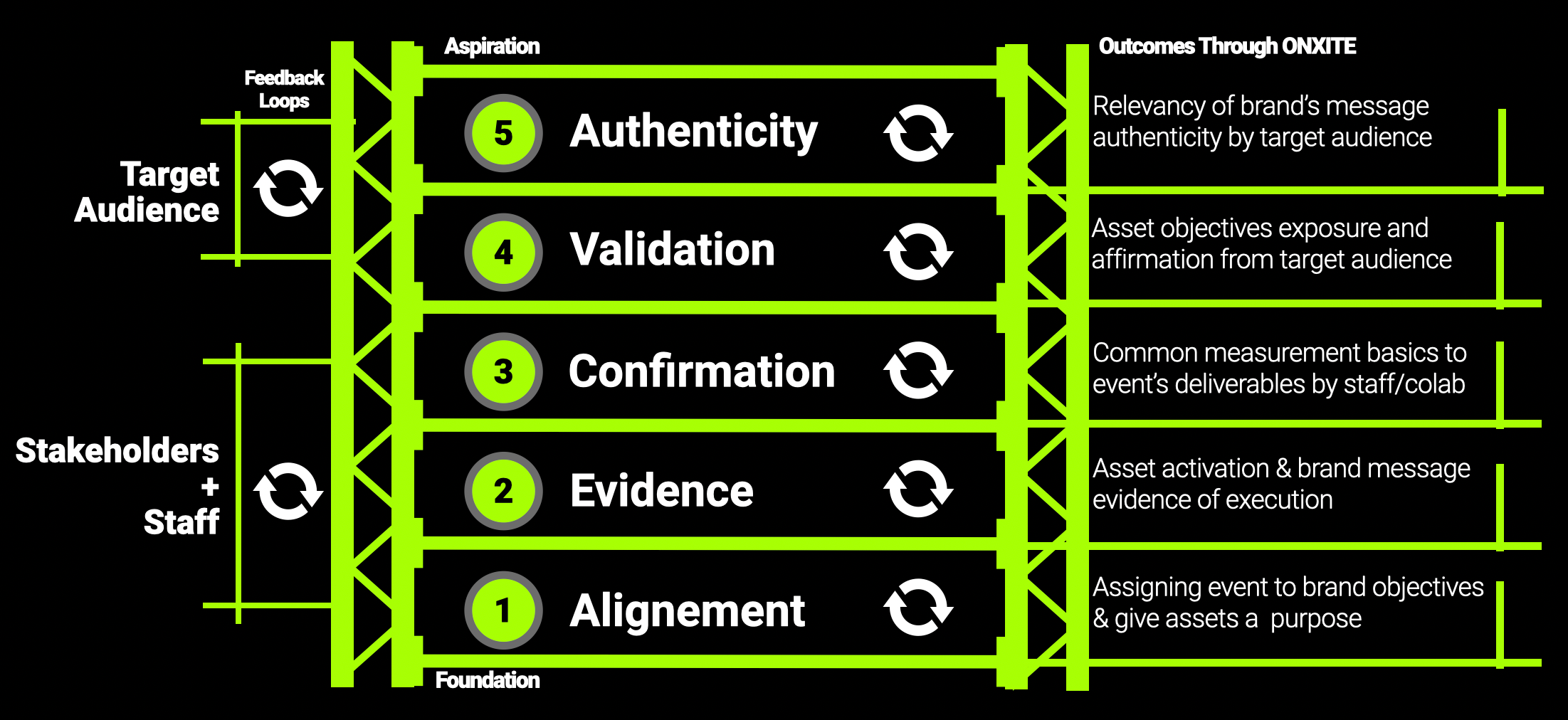
I think about this in terms of what I call the Scaffolding of Truth, a framework for building measurement that actually supports strategic decisions.
Level One: Alignment. Before you order a single item, know what objective it serves. Know what audience it's designed for. Know what behavior it's supposed to drive. Align assets to objectives, and objectives to business outcomes. Without this, everything else is noise.
Level Two: Evidence. Document that the distribution happened as planned. Photos, check-ins, inventory counts, but real counts, not estimates. Proof that the execution matched the plan.
Level Three: Confirmation. Apply common measurement basics. How many distributed? What was the reach? What was the engagement rate? This is where most programs stop.
Level Four: Validation. Did you reach the right audience? Did the item accomplish its objective? Connect the metrics back to the strategy. This is where your leadership lives, the CFO, the CMO. They don't care about distribution counts. They care about whether the investment delivered what it was supposed to deliver.
Level Five: Authenticity. Did the promotional product create a genuine moment that mattered to both brand and human? Did it serve the relationship, or did it just fill a tote bag? This is the aspiration, the proof that your experiential marketing is actually experiential.
[Onxite’s Event Alignment Scaffolding Framework]
Most of the industry lives at Level One or Two. Sometimes Level Three if they're fancy. But Levels Four and Five? That's where swag stops being a giveaway and becomes a strategic asset. That's where event marketers stop being organizers and become strategists. That's where you earn the right to defend and grow your budget.
The promotional products industry doesn't have a creativity problem, it just runs on inertia.
When we can't connect those carefully designed, strategically sourced branded items to actual business outcomes, we're asking leadership to fund faith instead of performance.
The designation we give something shapes how everyone thinks about it, including ourselves.
So let's add branded or to the word giveaways, or better yet, if you use them to entice engagement, call them premiums, give them their worth!
Every branded water bottle is a potential data point. Every t-shirt is a verified touchpoint. Every promotional item is evidence that your message reached a human being, and if you're measuring right, evidence that it reached the right human being.
A $27 billion industry deserves better than the designation of a giveaway.
It deserves the recognition that even awareness has an audience. That reach without targeting is noise. That the moment of exchange is worth more than a thousand fleeting impressions. That swag, deployed strategically and measured properly, is one of the most powerful tools in experiential marketing's arsenal.
Track your tchotchkes. Know who received them. Prove the message was delivered.
Your budget depends on it.
* * *
Plan your promotional giveaways strategically with xotski’s calculator
* * *
Sources:
PPAI 2024 Distributor Sales Volume Estimate (February 2025) — $26.78 billion industry size
ASI Global Ad Impressions Study — 85% brand recall for branded apparel
LinkedIn Marketing Solutions Help — Impression definition: 300 milliseconds, 50% viewability
Lindgaard et al., Carleton University (2006), Behaviour & Information Technology — 50 millisecond visual judgment
Potter et al., MIT (2014), Attention, Perception, and Psychophysics — 13 millisecond image processing